Berber culture in the Atlas and Sahara isn’t a museum exhibit you visit — it’s the living culture of the people who make up most of rural Morocco, from the mountain villages around Mount Toubkal to the semi-nomadic communities of the pre-Sahara. Most travelers meet it without realizing it: the mint tea poured from height, the geometric patterns on a rug in your riad, the family running your desert camp near Merzouga.
This guide is for travelers who want to actually understand what they’re seeing, not just pass through it: who the Amazigh people are, how their culture differs between the High Atlas and the Sahara, the craft traditions worth knowing about before you buy anything, and how to visit a mountain village or join a homestay respectfully rather than as a spectator.
Amazigh or Berber? A Note on Terminology
Both terms are in active use, and it’s worth knowing why. “Berber” comes from the Latin barbarus, the Roman word for outsiders — it’s not a name the Imazighen (the plural form; singular Amazigh) gave themselves. “Amazigh,” which roughly translates to “free person,” is the term increasingly preferred in Moroccan academic, political, and cultural contexts, and it’s what you’ll see in official government usage today. “Berber” isn’t offensive and remains the more widely recognized term internationally, including in most travel content, which is why this guide uses both. When in doubt, “Amazigh” is the more respectful default.
Who Are the Amazigh People?
The Amazigh are North Africa’s indigenous population, present in Morocco long before Arab expansion reached the region in the 7th century. Today, Amazigh communities make up a substantial share of Morocco’s population, concentrated in three main linguistic and geographic zones: Tarifit in the Rif Mountains of the north, Tamazight in the Middle Atlas, and Tachelhit across the High Atlas, Anti-Atlas, and Sous Valley in the south.
Amazigh identity gained significant official recognition in recent decades. Morocco’s 2011 constitution made Tamazight an official language alongside Arabic — Article 5 of the constitutional text states Tamazight “constitutes an official language of the State, being common patrimony of all Moroccans without exception” — ending decades of marginalization under earlier Arabization policies. A 2016 national census recorded roughly 28% of Moroccans as Tamazight speakers, though Amazigh rights groups argue the real figure, including passive speakers, is considerably higher. The language is now taught in public schools and appears on official signage in Tifinagh, one of the world’s oldest writing systems, with roots in ancient Libyan script going back over 2,500 years. The modern standardized version of the script was developed by the Royal Institute of Amazigh Culture (IRCAM), the government body founded in 2001 to promote Amazigh language and culture.
Amazigh Life in the High Atlas
The High Atlas is where most travelers first encounter Amazigh culture directly, usually through villages like Imlil and neighboring Aroumd, the trailhead villages for Mount Toubkal, North Africa’s highest peak. These are working agricultural communities, not recreations: terraced fields of walnuts, apples, and barley climb the valley walls, irrigated by channels (seguias) that have directed mountain meltwater to fields for generations. Homes are traditionally built from packed earth (pisé) or stone, clustered tightly together, often arranged around a shared courtyard for family compounds and craft work.
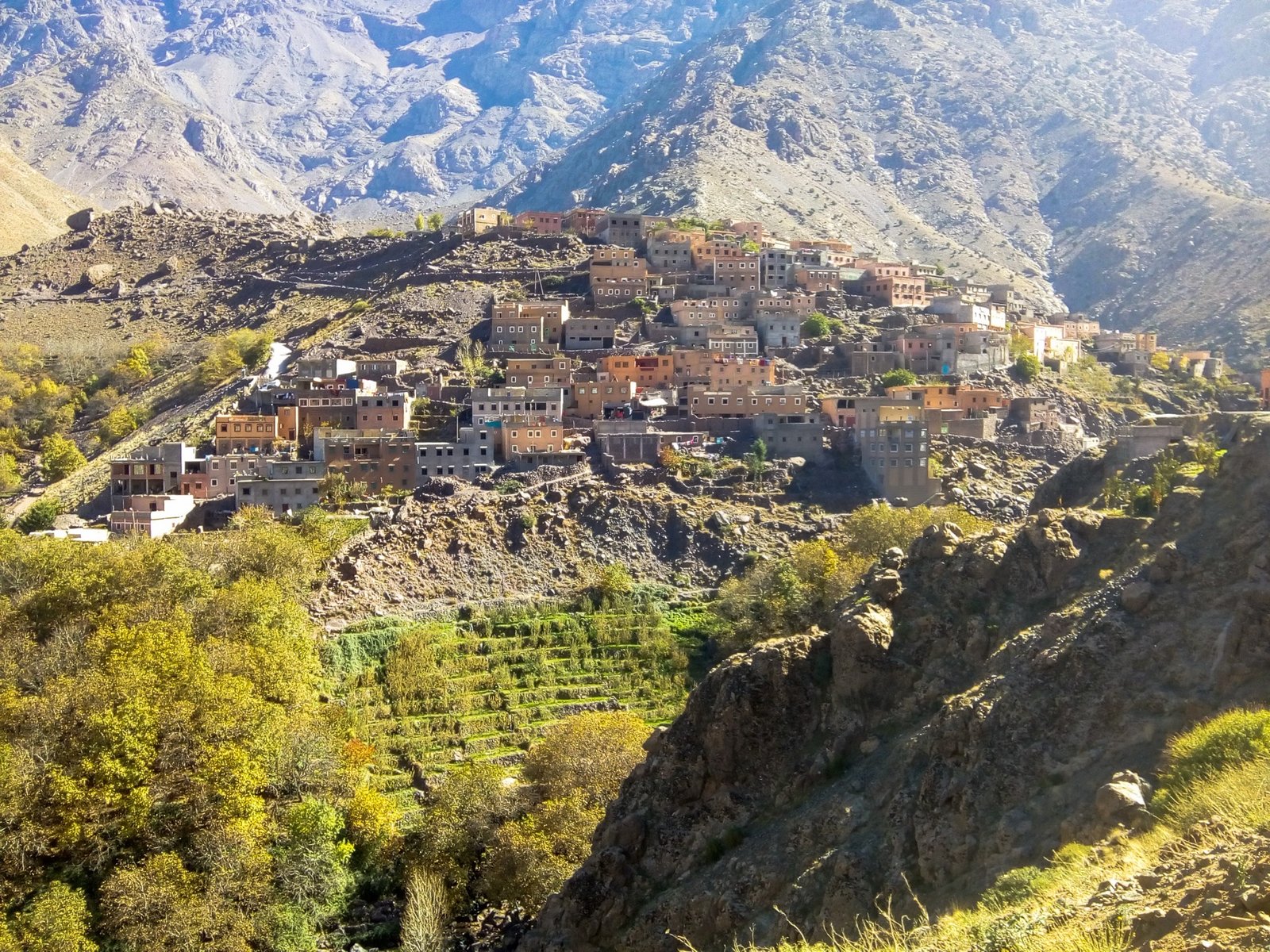
Many High Atlas families host travelers directly, offering mint tea, a home-cooked meal, or an overnight homestay — a genuinely good way to support the local economy directly rather than through an intermediary, and usually arranged through a local guide or trekking operator rather than showing up unannounced.
Amazigh Life in the Sahara and Pre-Sahara
Further south, toward Merzouga, Zagora, and the pre-Sahara, Amazigh communities historically followed semi-nomadic and nomadic patterns, moving herds seasonally between oases and grazing land. This is a genuinely different culture from the High Atlas farming villages, adapted to a much harsher environment: earthen ksour (fortified villages, singular ksar) like Ait Ben Haddou were built by Amazigh and Amazigh-Arab communities along historic trans-Saharan trade routes, with thick walls designed for insulation and defense rather than decoration.
A common point of confusion worth clearing up: Morocco’s Sahara-adjacent Amazigh communities are not the same as the Tuareg, the indigo-clad “blue men of the desert” associated with Mali, Niger, and southern Algeria. Tuareg groups speak their own Amazigh language variety and have a distinct culture, historically centered on trans-Saharan trade routes further south and east. Desert camps near Merzouga are typically run by local Amazigh families from the immediate region, not Tuareg communities, even though camp branding sometimes borrows Tuareg-associated imagery like indigo turbans for visual effect.
Craft Traditions: Carpets, Silver, and Argan Oil
Amazigh material culture is genuinely worth understanding before you shop for it, especially rugs — the single most common souvenir purchase tied to Amazigh craft.
Carpets: A Woven Language
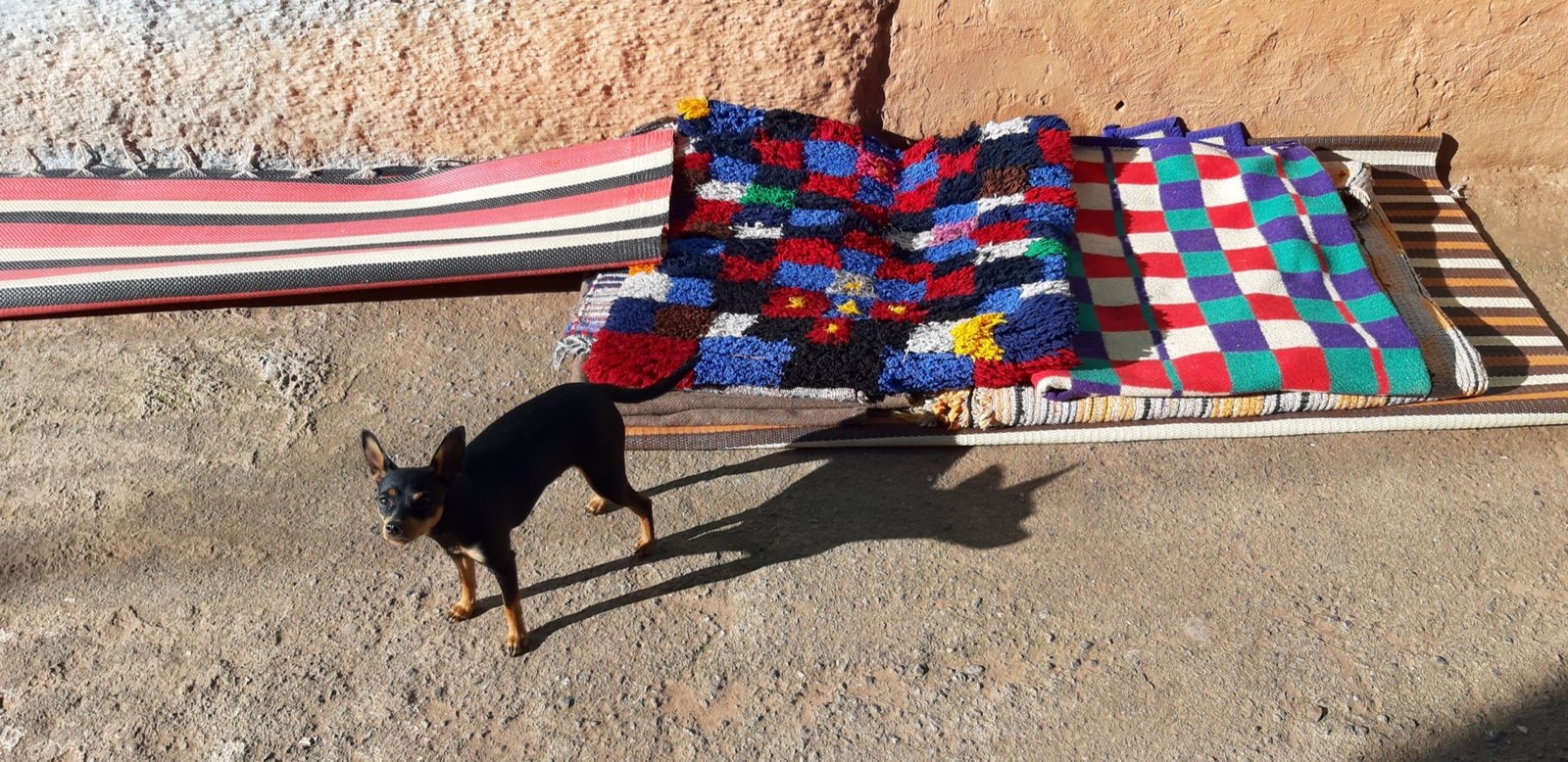
Amazigh rug-weaving is a matriarchal tradition passed from mothers to daughters, and the geometric patterns aren’t decorative filler — they’re a visual language, often woven without a fixed template, shaped by the weaver’s own life and region.
| Symbol | Common meaning |
|---|---|
| Diamond | Protection against harm |
| Zigzag | Water, fertility, or mountains |
| Triangle | Femininity and new beginnings |
| Cross | Balance and harmony |
| Chevron | Harvest and abundance |
Each region and tribal group developed distinct motifs and color palettes — the cream-and-brown geometric rugs known as Beni Ourain, woven by a collective of High Atlas tribes, are the style most recognized internationally, but they’re one of many regional traditions, not the only “authentic” one.
Argan Oil and Women’s Cooperatives
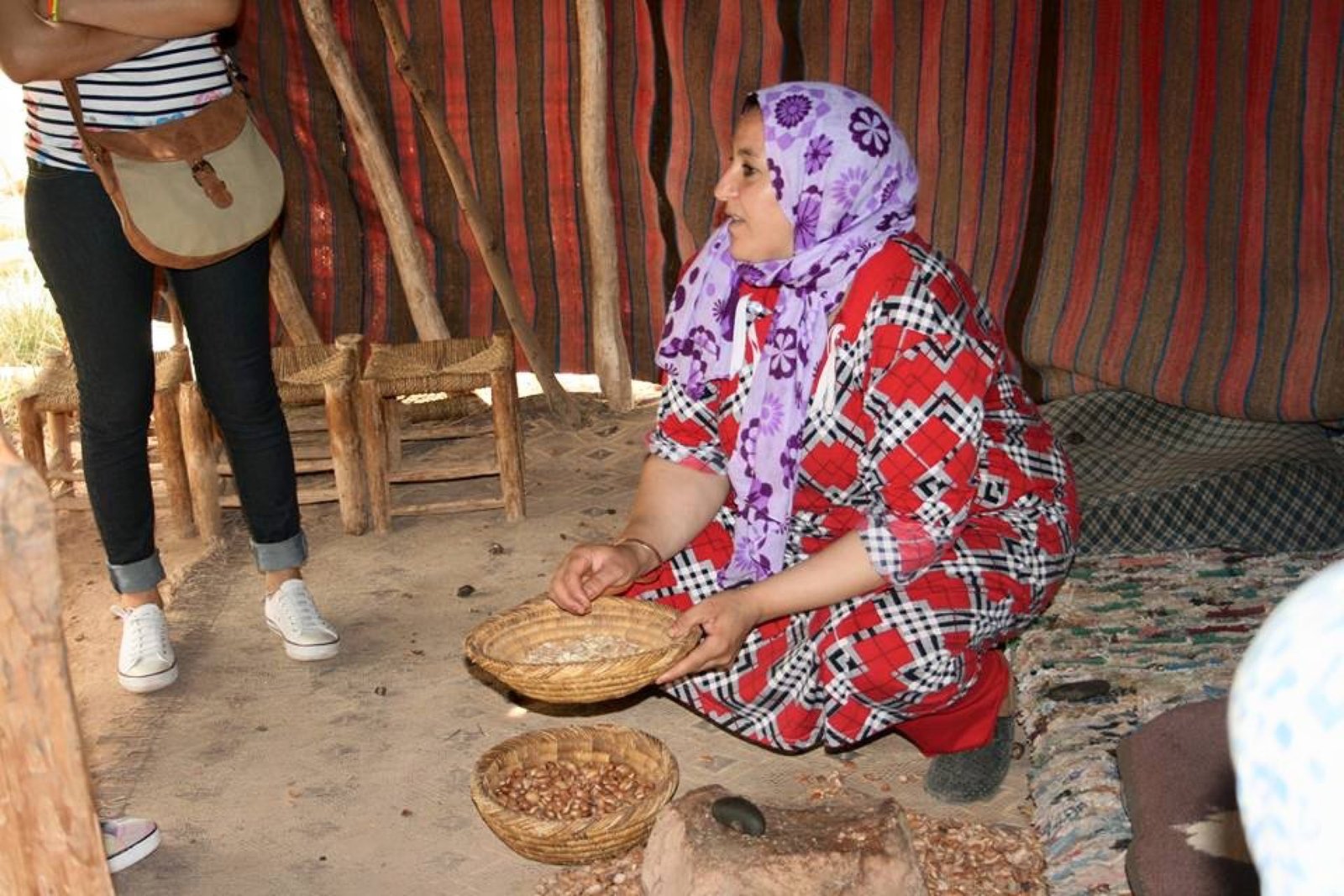
Argan oil, pressed from the nut of a tree endemic to southwestern Morocco, has been produced by Amazigh women for generations. Before the late 1990s, women typically sold it to middlemen for a fraction of its value; the cooperative model that’s now widespread — women collectively owning production, setting their own prices, and selling directly — changed that considerably. Buying from a genuine cooperative, ideally one with visible fair-trade or organic certification, puts money directly into the hands of the women producing it rather than a reseller. If you’re budgeting for rugs, argan oil, or other crafts as part of your trip, our Morocco travel cost breakdown covers realistic price ranges so you can bargain from an informed position rather than guessing.
Yennayer: The Amazigh New Year
Yennayer, the Amazigh New Year, falls on January 14 and marks the start of the agricultural calendar — the Amazigh year 2026 CE corresponds to year 2976 by traditional reckoning. In 2023, King Mohammed VI declared Yennayer an official, paid national holiday, and it has been observed as one since January 2024 — a significant, relatively recent milestone in Amazigh cultural recognition that most travel content hasn’t caught up to yet. If your trip falls around mid-January, you may see markets, family gatherings, and traditional dishes tied to the harvest and the new agricultural cycle, particularly in Amazigh-majority regions.
How to Experience Amazigh Culture Respectfully
These are specific to villages and homestays; for broader etiquette, bargaining norms, and cultural basics across Morocco, see our Morocco travel tips guide.
- Ask before photographing people. A smile, a gesture toward your camera, and a questioning look is universally understood. If someone declines, accept it without pushing.
- Arrange village visits and homestays through a local guide or operator rather than showing up unannounced — it respects people’s time and usually means your visit genuinely benefits the family rather than just satisfying curiosity.
- Buy crafts from cooperatives and artisans directly where possible, rather than only from resellers in tourist-zone shops in Marrakech or Fes.
- Dress modestly in villages, the same baseline that applies elsewhere in rural Morocco — shoulders and knees covered. See our what to wear in Morocco guide for the full picture by setting.
- Accept hospitality graciously. If you’re offered mint tea or a meal, accepting it (with your right hand) is part of the exchange, not an imposition on you.
- Don’t treat a village as a photo backdrop. It’s easy to slip into treating a working community as scenery; a little awareness of that tendency goes a long way.
Where to Experience Amazigh Culture
| Where | What you’ll find |
|---|---|
| Imlil & the Toubkal region | Mountain villages, trekking guides, homestays, terraced agriculture — see our Atlas Mountains day trips guide |
| Ourika Valley | Easier day-trip access from Marrakech; villages, waterfalls, weekly souks |
| Ait Ben Haddou | UNESCO-listed ksar showing traditional earthen Amazigh architecture |
| Essaouira – Agadir corridor | Concentration of women’s argan oil cooperatives |
| Merzouga & the Sahara | Desert camps typically run by local Amazigh families; camel treks, music |
If you’re building a route that includes both the High Atlas and the Sahara, our Morocco road trip itinerary covers the classic path between them via Ait Ben Haddou and the Dades and Todra gorges — the same route that passes through the heart of Amazigh pre-Sahara territory.
Common Misconceptions
- “Berber culture is a single, uniform thing.” It varies significantly between the Rif, Middle Atlas, High Atlas, and Sahara — different dialects, architecture, craft traditions, and ways of life.
- “Amazigh people live only in remote villages.” Amazigh identity spans rural and urban Morocco alike; many people in Marrakech, Agadir, and other cities are Amazigh, not only those in mountain or desert communities.
- “Berber and Tuareg are the same thing.” They’re related but distinct Amazigh-language cultures with different histories, geographies, and traditions — see the section above.
- “All Berber rugs are ‘Beni Ourain.'” That’s one well-known regional style among many; each weaving region has its own distinct patterns and materials.
If you’d like a route built specifically around Amazigh villages, cooperatives, and craft traditions rather than the standard highlights, contact our travel team to talk through a custom itinerary.
Frequently Asked Questions
Is it “Berber” or “Amazigh”?
Both are used. “Amazigh” (meaning “free person”) is the term communities use for themselves and is increasingly preferred in official and cultural contexts; “Berber” is an older, externally-imposed term that remains widely recognized internationally.
Is Tamazight an official language of Morocco?
Yes. Morocco’s 2011 constitution made Tamazight an official language alongside Arabic, and it’s now taught in public schools with growing use on official signage.
Are Berbers and Tuareg the same people?
No. Both are Amazigh peoples, but the Tuareg are a distinct group associated primarily with Mali, Niger, and southern Algeria, with their own language variety and history. Morocco’s Sahara-adjacent Amazigh communities are a separate group.
When is Amazigh New Year?
Yennayer falls on January 14 and has been an official paid public holiday in Morocco since 2024, following a 2023 royal decree.
Can tourists visit a Berber village?
Yes, and it’s a genuinely worthwhile way to understand Morocco beyond the main cities. Visiting through a local guide or operator, rather than unannounced, and following basic etiquette around photography and dress makes for a better experience for both sides.
What do the patterns on Berber rugs mean?
Common motifs include diamonds (protection), zigzags (water or fertility), triangles (femininity), and chevrons (abundance). Patterns and meanings vary by region and weaving tradition rather than following one fixed system.
Sources & References
- Institut Royal de la Culture Amazighe (IRCAM) — official Moroccan government institute for Amazigh language and culture
- Morocco’s Constitution of 2011 (Article 5) — the constitutional text establishing Tamazight as an official language
- UNESCO World Heritage Centre — Ksar of Ait-Ben-Haddou
- Visit Morocco — Moroccan National Tourist Office
Last updated: September 2026.